Having to wait 12 hrs for someone to hook your game system up for you because you're too lame to know how to do it is TORTURE!
Plagerism/Research
Monday, July 30, 2012
Tuesday, June 19, 2012
Friday, June 15, 2012
Archaeologocal Movies
| Apocalypto | The Body | Lord of the Rings Trilogy | The Mummy trilogy and The Mummy trilogy | Valkyrie | War & Peace |
|
| Casablanca | (1942) | National Treasure | Dominion: Prequel To The Exorcist | El Cid 1961 |
Diciplines of Archaeology
- Assyriology (Mesopotamia)
- Phoeniciology (Phoenicia)
- Classical Archaeology (Greece and Rome)
- Egyptology (Egypt)
- Historical Archaeology (Studies civilizations that left behind written records)
- Prehistoric Archaeology (Studies civilizations that did not have any writing systems)
- Protohistoric Archaeology (Studies civilizations that has limited written records)
- Ethnoarchaeology (Studies of modern societies that resembles extinct ones)
- Taphonomy (Studies how objects decay and degrade over time)
Rosetta Stone 1
Above is how the stone is shown displaying by language.
The
Rosetta Stone was the original key to the decipherment of
hieroglyphics. It was a damaged stone (much of the top is missing), found by
Napoleon's invading army, at Rosetta (apparently French for Rashid) in northern
Egypt, in 1799. It was captured by the British while still in Egypt, and is now
in the British Museum. It is a stela (or stele, a stone with writing carved on
it) with the same message (a decree from Ptolemy V) repeated three times, in
hieroglyphics (Late Egyptian), in Demotic (another version of Egyptian), and in
Greek. The first 26 or so lines are missing from the hieroglyphic part. The
Rosetta Stone enabled Champollion and others to finally make progress
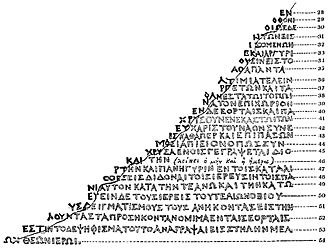
deciphering hieroglyphics. Here are all 14 lines, as best I can do from
examining photographs (with a few question marks for signs that couldn't be
figure out):
What is the Rosetta Stone?
The
Subscribe to:
Posts (Atom)